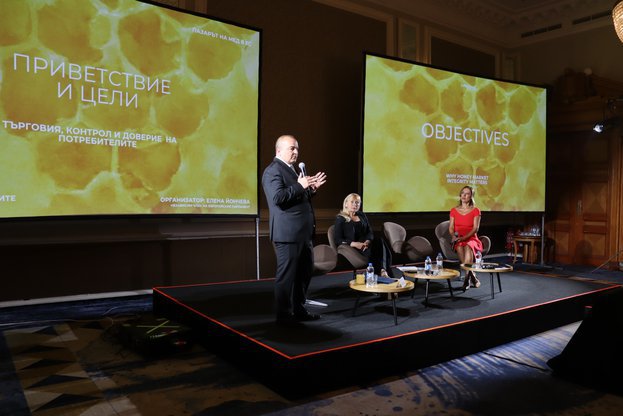
"Effective control over the quality and origin of honey is necessary to guarantee the protection of both consumers and Bulgarian producers." This was stated by the Minister of Agriculture and Food, Plamen Abrovsky, during a conference titled "The Honey Market in the EU" held in Sofia.
In his speech, he shared a personal story with his father-in-law, who is a beekeeper. According to him, it was from his father-in-law that he learned that real honey inevitably crystallizes, and the sugaring process is a natural sign of its authenticity. Minister Abrovsky pointed out that in the presence of impurities, honey forms different layers during crystallization, which is also an indicator of its quality. He noted that while such practical knowledge is valuable, it could not replace the need for reliable laboratory control. The Agriculture Minister supported the necessity of a laboratory to verify the authenticity of honey. He emphasized that the lack of such capacity hinders the fight against counterfeiting and places honest producers at a disadvantage. He also highlighted Bulgaria's unique natural endowments for producing high-quality honey. As an example, he pointed to the Rhodope Mountains, where limited agricultural activity and the low use of plant protection products create favorable conditions for beekeeping and the production of honey with exceptional taste and high added value.
Minister Abrovski also focused on the upcoming reform of the European Union's Common Agricultural Policy (CAP). He recalled his active participation over the years in the preparation and implementation of European policies in the sector, expressing the opinion that successive reforms have failed to achieve their primary goal: increasing the competitiveness of European farmers on global markets. According to him, instead of creating conditions for joint development and expanding the presence of European products internationally, the current mechanisms increasingly place producers from Member States in direct competition with one another within the single European market. The Minister argued that the future Common Agricultural Policy must encourage coordinated actions, increased competitiveness, and a more active presence of European agricultural goods in third-country markets. He noted that Bulgaria has consistently defended this position during discussions at the Council of the European Union.
During the discussion, the issue of insufficient laboratory capacity to distinguish between natural Bulgarian rose oil and synthetic alternatives entering the European market was also raised. Minister Abrovski pointed out that this problem affects both honey and rose oil, where the lack of reliable control creates conditions for unfair competition and complicates the protection of producers.
In conclusion, the Minister stated that control is not an end in itself, but a necessary instrument for ensuring the quality and authenticity of Bulgarian agricultural products. In his words, only by clearly distinguishing between genuine products and imitations can consumer interests be protected, fair conditions for producers be ensured, and the groundwork be laid for the sustainable development of high-value-added sectors.
Speaking to journalists, Minister Abrovsky discussed the so-called "Iranian aid," which provides support to farmers specifically for fuel and fertilizers. He explained that the budget contains sufficient funds to grant this to farmers. There are two options for this support, he noted: the first is based on actual expenses incurred, and the second is based on estimates from technological charts. "In my opinion, it is better to base this on actual expenses to avoid excessive distortions between different sectors," Minister Abrovsky stated, adding that the State Fund "Agriculture" is currently reviewing possibilities for the individual calculation of the aid. He noted that given the Fund's heavy workload with reviewing projects under the Rural Development Programme, the application intake for the "Iranian aid" will most likely open in late August, ensuring that payouts can begin by early autumn. "We will discuss increasing support for the Livestock sector at a later stage, in the autumn, once we can assess the remaining resources under the programs," the Minister noted. He clarified that aid for livestock breeders is ongoing, as funds are regularly disbursed according to the indicative schedule. Responding to a journalist's question regarding Europe's allowance for alternative liquidity measures and the potential use of the crisis reserve, Minister Abrovsky announced that analyses are underway and that he intends to present Bulgaria's position on activating the European Commission's crisis reserve at the next Council of Ministers.
Regarding the state's actions concerning the problematic butter on the market, the Agriculture Minister stated that inspections are ongoing, and that the final results, once available, will be announced publicly. He stressed the importance of removing this product from the market.